Moving cars between countries
Importing an air-cooled Porsche into the United Kingdom
A classic Porsche that is at least 30 years old, original and no longer in production comes into the UK at 0% duty and an effective 5% VAT. A used car that doesn't qualify pays the standard 10% duty (0% for EU-origin cars with proof of origin) and 20% VAT. Either way, tell HMRC within 14 days, then register with the DVLA.
By Jon Kennedy, Porsche Enthusiast
Last reviewed 25 October 2026, against the official sources linked in each section. Rules change: confirm with the agency before you ship.
Do this next
- 1Decode the chassis number, then check the build date on the car's papers: the 30-year test counts the year of manufacture.
- 2Ask HMRC for an Advance Tariff Ruling before you ship. It can't be issued once the car reaches customs.
- 3Find a UK specialist for transport, registration or the first MOT.
- 4Buying the car in Japan? Follow the Japan to UK steps.
In short
- Historic rate (30+ years, original)
- 0% duty, 5% effective VAT
- Standard rate, used car
- 10% duty, 20% VAT
- Tell HMRC (NOVA)
- Within 14 days of arrival
- First registration fee
- £55

The car carrier Manon moored at Southampton, where roll-on, roll-off ships load and unload vehicles.
Does a classic Porsche qualify for 5% VAT on import?
Yes, if it's classed as a collector's car under tariff heading 9705: then it pays 0% duty and an effective 5% VAT, because the value for import VAT is reduced to 25% and charged at 20%. The car must be in its original state without substantial changes to chassis, body, steering, brakes, transmission, suspension or engine, be at least 30 years old, and be a model no longer in production. Repair and restoration are allowed; modified cars are not.
Every air-cooled model except the 993 now passes the age test outright. HMRC recommends asking for an Advance Tariff Ruling before you import, because it can't be issued once the car is presented to customs.[1][2][3][4]
| Model | Built | Age test in 2026 |
|---|---|---|
| Porsche 356 | 1948–1965 | Every car already qualifies on age |
| Porsche Early 911 | 1964–1973 | Every car already qualifies on age |
| Porsche 912 | 1965–1969 | Every car already qualifies on age |
| Porsche 930 Turbo | 1975–1989 | Every car already qualifies on age |
| Porsche 911 SC | 1978–1983 | Every car already qualifies on age |
| Porsche Carrera 3.2 | 1984–1989 | Every car already qualifies on age |
| Porsche 964 | 1988–1994 | Every car already qualifies on age |
| Porsche 993 | 1993–1998 | Cars built 1993 to 1996 qualify; later cars from 2027 |
Our take: For a 1997 or 1998 993 bought outside the UK, the 30-year date is worth planning around. Paying 5% VAT instead of 20% VAT plus 10% duty is a large difference on any car worth shipping, so check when the car turns 30 and get the ruling before you commit.
What does a car that doesn't qualify pay?
It goes under heading 8703: a used petrol car over 1,500cc pays the standard 10% duty and 20% VAT, charged on the car plus accessories, delivery and the duty. EU-origin cars show a 0% preferential duty rate, with proof of origin.[5][6]
| Classic rate (9705) | Standard rate (8703) | |
|---|---|---|
| Age | 30 years or older | Any |
| Condition | Original, no substantial changes | Any |
| Duty | 0% | 10% (0% for EU origin with proof) |
| VAT | 5% effective | 20% |

A container ship under the cranes at Felixstowe.
How do you tell HMRC about an imported car?
Every permanent import must be notified to HMRC within 14 days of arrival, through the Notification of Vehicle Arrivals (NOVA) system, and the car can't be registered until that's done. For a private importer, the shipping company or customs agent makes the declaration, or HMRC's CARS team does if you bring the car in yourself. Late notification can be fined.
NOVA needs the import documents (C88 and E2, or the MRN), the invoice or bill of sale if you bought the car in the last six months (otherwise a UK valuation), and an official document showing the VIN or chassis number.[7]
How do you register an imported classic car with the DVLA?
Cars over 10 years old don't need vehicle approval (IVA), which covers every air-cooled Porsche. Register on form V55/5 with the original foreign registration document (or a letter saying why it's missing plus a dating certificate), proof of a valid MOT, proof of name and address, and the £55 first registration fee. Allow 48 hours after HMRC confirms NOVA before contacting the DVLA, which may inspect the car.
The DVLA issues a registration number that matches the car's age, using the first registration date on the foreign document or evidence of the month and year of manufacture. Without proof of age the car gets a Q plate. Before registration it may be driven on the road only to a pre-booked MOT or approval test.[8][9][10]
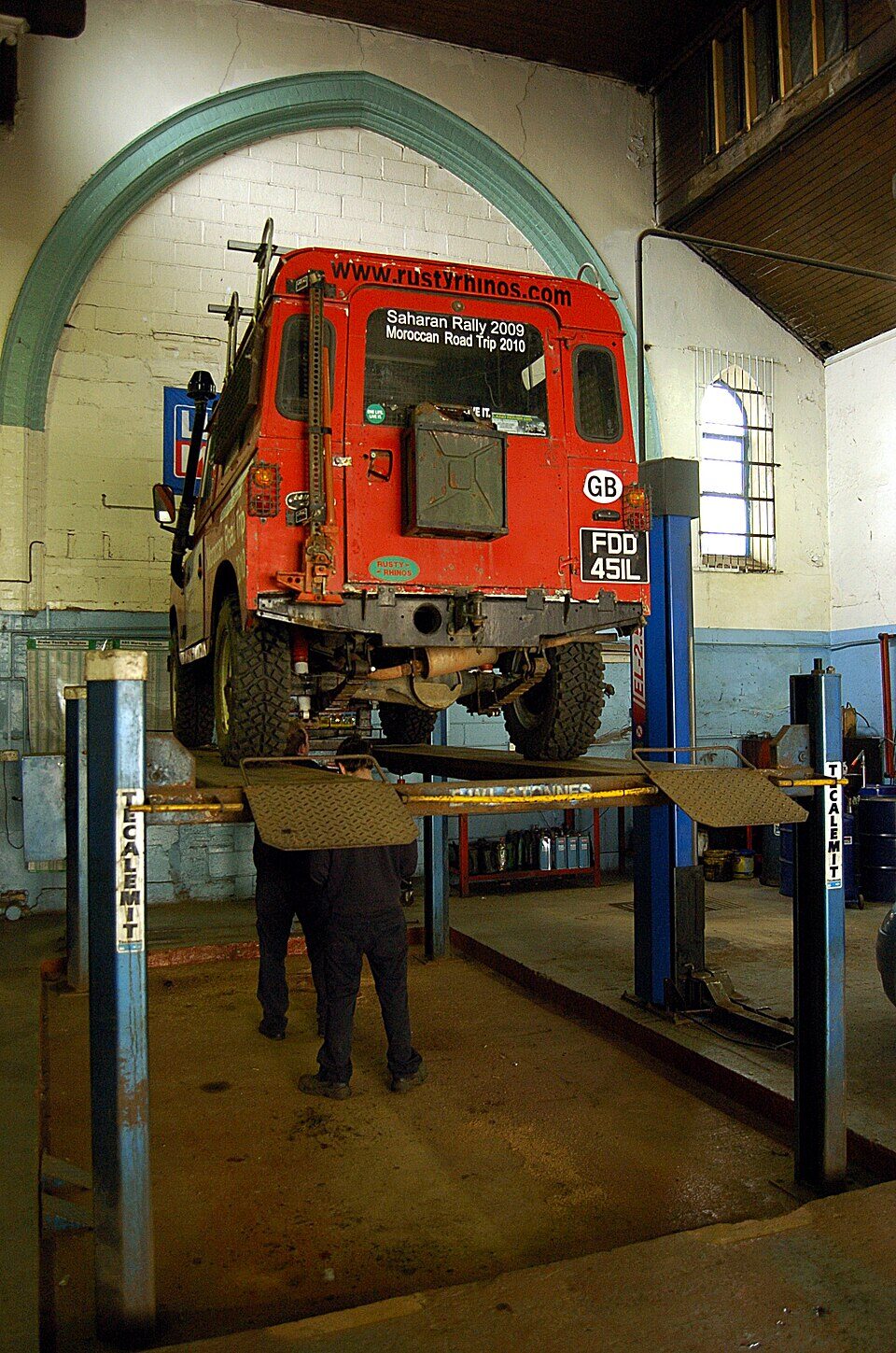
A Land Rover Series IIA on the lift for the chassis inspection of its MOT test.
Do classic Porsches pay road tax or need an MOT in the UK?
From 1 April 2026, cars built before 1 January 1986 can go in the historic vehicle tax class and pay no vehicle tax. You still tax the car, at £0, at a Post Office. The DVLA sets the rule as first registered more than 40 years ago, from 1 April each year, so later cars join as they reach 40.
Cars built or first registered more than 40 years ago don't need an MOT if they've had no substantial changes in the last 30 years; you declare the exemption when you tax. Q-plated cars, kit cars and reconstructed classics are excluded, and the car must still be roadworthy.[11][12][13]
Is importing a classic Porsche from Japan to the UK any different?
Not under UK rules: the 30-year collector's test, NOVA and DVLA registration apply whichever country the car comes from. A qualifying car still pays 0% duty and an effective 5% VAT.
The UK–Japan trade agreement won't cut the 10% duty on a car that doesn't qualify. Its lower rates are for goods wholly obtained or sufficiently processed in the UK or Japan, and a Porsche built in Germany is neither.
Before it leaves, the car is deregistered in Japan and the owner gets an export certificate on a Japanese and English form, valid for six months. Send it with the V55/5 as the original non-UK registration document; the DVLA keeps it, so copy it first.[6][9][14][15]
Our take: A Japanese-market Porsche is still a German car on paper. Whether it passes the 30-year collector's test, not the ship's port of departure, decides what you pay.
Help in the United Kingdom
4 specialists in the United Kingdom list transport, import or registration help: Autofarm, Paul Stephens, R&D Automotive Ltd, Porschemode.
All specialists in the United KingdomImport and registration specialists
Questions
No. The UK–Japan agreement's lower rates only cover goods made or substantially processed in Japan or the UK, so a German-built Porsche gets the same 0% (collector's car) or 10% duty as one shipped from anywhere else.
Only once it is at least 30 years old, original and the model is out of production, the conditions in chapter 97 of the UK tariff. A 993 built in 1996 meets the age test in 2026; 1997 and 1998 cars reach it in the following years. HMRC recommends an Advance Tariff Ruling before import.
14 days from arrival, using NOVA. Private importers usually have their shipping company or customs agent do it. The car can't be registered with the DVLA until HMRC has been told.
Yes, if you can prove its age. The DVLA uses the first registration date on the foreign document or evidence of the month and year of manufacture, such as a dating certificate. Without it, the car gets a Q plate.
From 1 April 2026, cars built before 1 January 1986 can use the historic vehicle tax class and pay £0. The cut-off moves on each April, so later 911s join as they reach 40.
Sources
Each section is numbered to the official pages it was written from, with the date each page shows.
- UK Trade Tariff: chapter 97 notes (Read 25 October 2026)
- UK Trade Tariff: 9705 10 00 45 (Read 25 October 2026)
- HMRC: How to value goods for import VAT (Updated 1 October 2022)
- HMRC: Classifying vehicles (Updated 23 April 2021)
- UK Trade Tariff: 8703 23 90 00 (Read 25 October 2026)
- GOV.UK: Paying VAT and duty
- GOV.UK: Telling HMRC (Updated 10 December 2024)
- GOV.UK: Exemptions from vehicle approval
- DVLA INF106: How to import a vehicle (PDF) (October 2025)
- GOV.UK: Importing vehicles into the UK (Updated 10 December 2024)
- GOV.UK: Historic vehicles (Updated 24 January 2025)
- DVLA INF34: Taxing historic vehicles (PDF) (March 2025)
- DVSA: MOT exemption criteria (Updated 19 May 2026)
- GOV.UK: Summary of the UK-Japan Comprehensive Economic Partnership Agreement (updated 20 December 2024)
- JETRO (Japan External Trade Organization): documents and procedure for exporting a used car from Japan (updated August 2025)
Written from the official pages linked under each section, for importing a car for personal use. It isn't legal or tax advice. Where an agency's site couldn't be read we cite the law itself and say so. Spot something out of date? Tell us and we'll check it.